
 Saurabh Agrawal
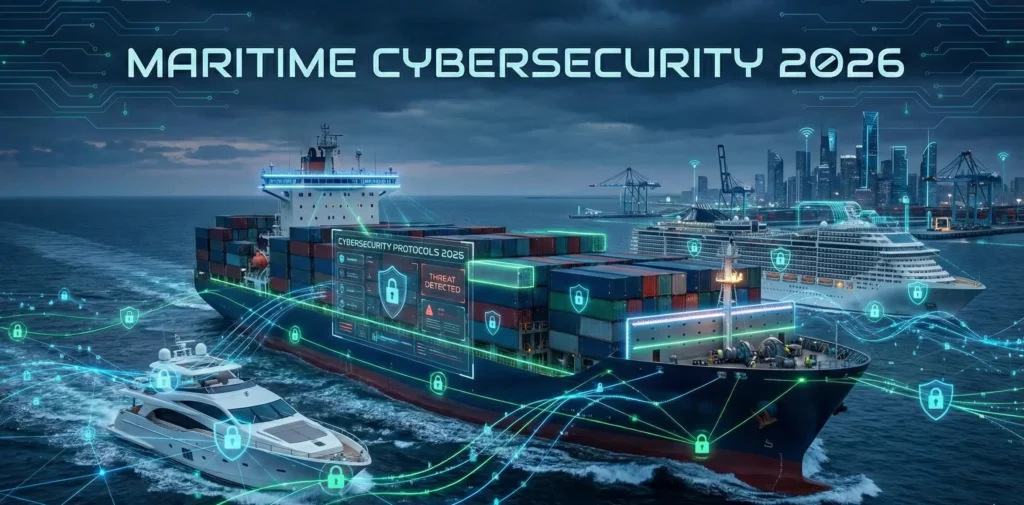
 The maritime industry stands at a critical point. As vessels become increasingly digitised and interconnected, they’ve simultaneously become attractive targets for cybercriminals, state-sponsored actors, and ransomware groups.
For ship operators, IT managers, and maritime security officers, understanding and implementing comprehensive maritime cybersecurity solutions is no longer optional – it’s a regulatory requirement and operational necessity.
This guide explores the evolving threat landscape, compliance mandates, and practical security protocols that will define vessel cyber threat protection in 2026 and beyond.
Why Vessels Have Become Prime Targets for Cyber Attacks in 2026
The maritime sector has experienced a dramatic increase in cyber incidents over the past three years. Unlike traditional piracy, modern cyber attacks on vessels are sophisticated, remote, and capable of crippling operations without a single person boarding the ship.
Several factors have converged to make vessels particularly vulnerable:
Legacy Systems Integration: The legacy systems were never designed with cybersecurity in mind, creating inherent weaknesses in vessel SCADA protection protocols.
Increased Connectivity: The proliferation of VSAT and satellite internet services has opened multiple entry points for cyber intrusions if not properly secured through ship network segmentation.
Supply Chain Complexity: A single vessel might interact with dozens of entities, each representing a potential vulnerability.
Crew Vulnerabilities: Despite technological advances, human error remains the weakest link.
IMO 2025 Cybersecurity Requirements: What Ship Operators Must Know
The International Maritime Organization (IMO) has positioned cybersecurity as a fundamental component of maritime safety management.
Understanding and implementing these requirements is critical for maintaining operational compliance and avoiding costly detentions.
The IMO’s approach to maritime cybersecurity emphasizes a risk-based methodology that requires ship operators to:
- Identify Threats and Vulnerabilities
- Implement Protective Measures
- Detect Anomalies
- Respond and Recover
Classification Society Requirements
Beyond IMO guidelines, classification societies have developed specific cybersecurity standards that impact vessel certification and insurance coverage:
IACS UR E26 and E27: IACS UR E26 establishes baseline standards for protecting computer-based systems that could affect vessel safety, while IACS UR E27 focuses on securing data exchange between vessels and shore-based entities.
ABS Cyber Safety Requirements: The American Bureau of Shipping (ABS) has developed comprehensive cyber safety guidance and notation programs that provide frameworks for implementing maritime OT security measures.
BIMCO Guidelines: The Baltic and International Maritime Council (BIMCO) has published practical guidelines for maritime cyber security that complement regulatory requirements with industry best practices, particularly useful for developing ship cyber security training programs and incident response procedures.
Regional and National Compliance Layers
Maritime cybersecurity compliance extends beyond IMO requirements to include regional directives and national regulations:
NIS2 Directive Maritime Requirements: For vessels operating in EU waters, the updated Network and Information Security (NIS2) directive imposes stringent cybersecurity obligations on critical infrastructure operators, including shipping companies.
USCG Cybersecurity Compliance: The United States Coast Guard has incorporated cybersecurity assessments under the maritime ISPS code cyber framework. Vessels calling at US ports must demonstrate compliance with cybersecurity best practices or face potential detention.
Port Facility Security Integration: Many major ports now require vessels to demonstrate cybersecurity compliance as a condition of entry, with some facilities mandating specific security protocols for ship-to-shore data exchanges and interface protections.
Beyond Antivirus: Building Defense-in-Depth Security at Sea
Comprehensive vessel cyber threat protection requires layered security architectures that create multiple defensive barriers between attackers and critical systems.
A robust defense strategy for vessels includes:
- Network Segmentation
- Robust Firewall Architecture
- Access Control and Identity Management
- Endpoint Protection Beyond Traditional Antivirus
- Security Monitoring and Logging
Ship operators must view cybersecurity not as an IT expense but as an operational necessity equivalent to engine maintenance or safety equipment – essential for protecting crew, cargo, and business continuity.
Integrating VSAT and Starlink: Managing Bandwidth and Security Trade-offs
Satellite communications have revolutionised maritime operations, enabling everything from real-time weather routing to crew video calls.
However, the bandwidth abundance delivered by traditional VSAT and newer Starlink services also expands the attack surface, requiring careful security architecture to protect vessel systems.
Security Challenges of Satellite Internet at Sea
The expansion from limited bandwidth connections to high-bandwidth services creates several security considerations:
- Higher exposure to malware, phishing, or other threats.
- Increased Cost Versus Security
- Firmware and Equipment Security
Continuous Monitoring and Threat Detection
Satellite communications enable continuous security monitoring that was impractical with limited connectivity:
- Cloud-Based Security Services
- Remote Security Operations Center (SOC) Support
- Automated Incident Response
Remote IT Monitoring: Preventing Downtime Before It Happens
Remote IT monitoring transforms vessel IT management from periodic maintenance to continuous oversight, identifying and resolving issues before they impact operations.
Comprehensive remote IT monitoring for vessels requires integration of several technical capabilities:
- Network Monitoring: Continuous tracking of network device health, bandwidth utilization, connection quality, and traffic patterns.
- Server and Workstation Monitoring: Continuous tracking the health and performance of computing systems.
- Security Monitoring: Beyond general IT monitoring, including endpoint protection, firewall configuration validation and intrusion detection etc.
- Continuous Satellite Communications Monitoring.
Conclusion: Charting the Course for Maritime Cyber Resilience
As we navigate through 2026 and beyond, maritime cybersecurity has transitioned from an emerging concern to a fundamental operational requirement.
The convergence of regulatory mandates, sophisticated threat actors, and increasing vessel digitization demands that ship operators approach cybersecurity with the same rigor applied to traditional safety management.
About PiscesER1 Marine
Pisces ER1 Marine specializes in comprehensive ship IT security services and maritime cybersecurity solutions for modern shipping fleets. We understand the unique challenges vessel operators face in protecting increasingly connected ships while maintaining operational efficiency and regulatory compliance.
Our commitment to excellence isn’t just marketing language – it is result oriented. When a global dry-bulk shipping company operating vessels across the USA, Singapore, and Denmark struggled with high IT downtime, fragmented vendors, and uncontrolled technology costs, we delivered a centralized, proactive Vessel IT operating model that transformed performance and profitability:
- Recovered 400+ man-hours per month
- Reduced IT operating cost by $19,000 per vessel per year (down from $33,000 to $14,000 per vessel)
- Delivered 99.9% system uptime across 50 onboard servers
- Cut emergency travel and troubleshooting costs by 94%
- Improved incident resolution efficiency to 49% First-Call Resolution
- Implemented fleet-wide IT modernisation and cybersecurity upgrades
These aren’t isolated successes. We’ve delivered more than one hundred successful ship projects, consistently meeting estimated delivery dates and maintaining clear communication throughout complex implementations.
Contact us today to discuss how we can help protect your vessels, ensure compliance, and maintain operational resilience in an increasingly connected maritime environment.
🌐 pisceser1marine.com/contact-us/
📧 operations@pisces.seastella.in
📞 +91 22 62215299

 Sandeep Kumar